Our principal radar system products include wind profilers, meteor radars, ionospheric radars and frequency and time synchronised radar stations. We cover MF, HF and VHF frequency bands. Radars range in scale from meteor radars and boundary layer troposphere radars employing transmitter powers from 7.5 kW or so, to MST-class radars employing very large antenna arrays and 100’s of kW of transmitter power.
In addition to complete solutions we supply radar sub-systems including antenna systems, transmitters, transceiver systems, receiving systems, data acquisition systems, and associated software.We also supply radar items at the component level including antennas, baluns, power splitter/combiners, transmit/receive switches, RF filters, and DDS-based synthesisers.
In addition, we can provide cost-effective upgrades to existing radars. We provide a wide range of services from antenna array modeling and array design, RF engineering design, software design; to radar installation and maintenance; to radar operator and technical training.
Recent Developments
- Transceiver Module
We now have available a highly sophisticated transceiver module that provides a powerful and flexible building block for radars that require programmable beam forming and beam steering capability. The transceiver is implemented as two independent 2 kW channels in a single module. Each channel has independent phasing on both transmission and reception and the phasing is implemented using direct digital synthesis (DDS) techniques. A transmit/receive switch and a directional coupler are included in each channel. The directional coupler allows complex load impedance to be measured under full power on a pulse-to-pulse basis for optimum protection against load faults and for calibrating transmit path phase delays. A test signal may be injected into the output ports to allow swept VNA measurement of the load to be performed in test mode. The test signal may also be injected into the receive signal path to calibrate receive path phase delays for accurate beam forming on reception. The transceiver module includes low noise amplifiers and down-conversion to intermediate frequency (IF). The entire transceiver module is controlled by an on-board microcontroller which includes very comprehensive monitoring and diagnostics functionality.
- USB Vector Network Analyser
Genesis Software announces the release of the HTECH uVNA 7 USB Vector Network Analyser. The uVNA provides accurate and sophisticated network analysis measurements of antennas and electronic circuits at low cost. It finds application in radar site support; in electronics design, development and test activities; and in electronics teaching environments.
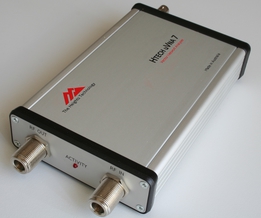 In radar systems, evaluating and optimising the performance of antennas and antenna arrays are fundamental requirements and a vector network analyser is an indispensable tool in the development, commissioning and maintenance of radar installations.
In electronics laboratories, the vector network analyser finds wide application in design, development and test measurements, and in fault finding and repair of electronic equipment.
The uVNA is a 2-port instrument to provide both reflection and transmission measurement capability. It is a calibratable instrument and applies the standard short, open, load calibration procedure.
Traditional portable and bench-top vector network analysers are highly sophisticated instruments that come at a commensurate high cost. Standalone portable instruments still tend to be bulky and weighty whereas the USB VNA is very small and lightweight and makes use of the ubiquitous laptop computer to provide control, processing, measurements display and storage functionality. In this way, it becomes an economical reality to broadly equip field stations, electronics development and test laboratories and teaching facilities with this powerful and sophisticated circuit analysis tool.
The USB Vector Network Analyser has been developed by experienced professional engineers and users to address key areas of radar, electronics design, development and test, and electronics engineering teaching applications.
Please refer to this document for more information:
- Frequency and Time Synchronised Radar Stations
High precision frequency references conditioned by GPS are used to frequency- and time-synchronise outlying receive-only radar stations with a transmit site. This capability has a wide range of user applications. For example, in an ionospheric radar application, outlying stations can be used to receive forward scatter from field-aligned irregularities. In meteor radar applications, outlying stations can be used to receive forward scatter from meteor trails to allow determination of meteor orbits. The frequency- and time-synchronised radar station is designed to operate in complete autonomy from the transmit site making it particularly suited for rapid deployment for campaign operation.
Product and Services Summary
Our principal radar products include:
- VHF wind profilers
- SKiYMET meteor radars
- Ionospheric radars
- MF radars
- Frequency and Time Synchronised Radar Stations (Bi/multi-static operation)
- Ionosondes
Radar sub-systems and components include:
- Pulse transmitter systems
- Pulse transceivers
- Receiving systems
- Data acquisition systems
- Antennas and antenna arrays
- Antenna baluns, antenna power splitter/combiners
- High power splitter/combiners
- Transmit/receive switches
Our services include:
- Active phased array design
- Antenna array modeling
- Consulting and collaboration
- Field trial services
- Radar system leasing
- Radar installation and maintenance services
- Radar operator and technical training
- RF engineering solutions
- Scientific analysis software
- Data format design and implementation
- SKiYMET is a joint development with MARDOC Inc.